Creating Conditions for Movement
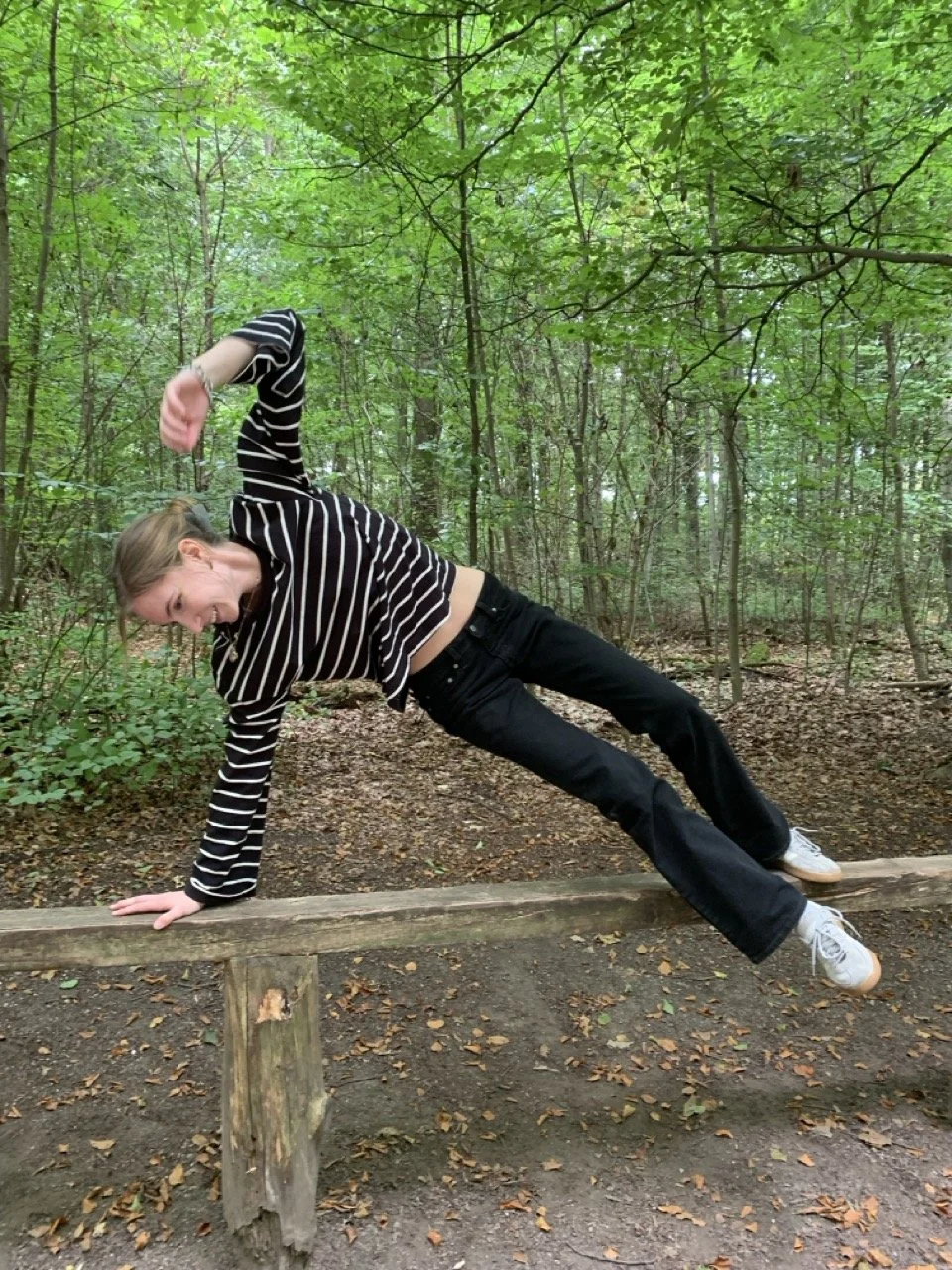
My movement method, “light space movement,” stems from my interest in how various practices understand the relationship between movement and the body and the effect it has on my daily life. It is the result of personal research and extraordinary motivation: not letting myself be defeated by the physical limitations caused by a health condition I’ve lived with for several years, the most prominent symptoms of which are fatigue and pain. What has been helping most to practice is:
1. Simplify the movement.
2. Give yourself enough time to notice what you are actually doing.
3. Adjust yourself according to your needs.
4. Simpler movements help you feel into the body more clearly.
5. Find a flow, stay out of your head for you to not be preoccupied with the choreography.
I keep comign back to these five phrases in my coaching sessions, over and over again.
It can feel counterintuitive to do less when what we actually want is to do more. When we want to get better at something, the instinct is usually to do more: more repetitions, more difficult exercises, more effort.
Initially, slowing down can feel like we're delaying that progress, but what it does is it changes the quality of how we are moving. When we move slowly or simply enough to pay attention, we create the conditions in which movement can actually change —
The practical application of this condition of movement comes into play in my method through the use and application of simple forms: — walking, standing up and sitting down, simple all-fours work — along with repetition and variation. a simple movement lets us work on how the body organises itself: how we shift weight, use the centre of the body to generate energy, coordinate effort and relaxation, and move with ourselves rather than against ourselves. And, strangely, it turns out to be a far more effective way of learning skills in depth.
Let’s take a super simple movement as an example: standing on one leg. If someoone tries to stand on one leg, it usually goes like this: the pull up one knee and then the struggle starts. Some fall to a side, some use strain and tense up to stay upright. I love simple movements like this, because it gives an opportunity to work through a lot of elements. First, starting with a stable base, meaning feet are hip or shoulder width apart. Bringing the body into a movable responsive position: softening the knees and hips, lengthening the lower back, inhaling to find length in the upper back, schoulders are soft. Now think of yourself having a pole that runs through you, a center of gravity, and shift your weight over to one leg – so you don’t lean your body sideways, but shift your weight while keeping the the pole running through you down to the ground. This by itself frees the other leg, which knee you can now easily pull in. Stable, balance and without tension. It is the same simple movement, but how it is done is totally different: the second version creates a better condition for this movement.
I have been thinking about this beyond movement practice, too.
Recently, I was writing with an artist who, like me, has to constantly negotiate with a body that does not have the energy she would like it to have. We talked about how difficult it can be to understand what your body needs BEFORE you flare. There is a persistent idea that we should be able to keep up with the rhythm of a given industry and just push through when we feel tired.
I can relate to that experience and challenge very well. Just as in my movement practice, slowness, kindness and softness are things I need and practice myself in my everyday life to allow myself to create the conditions I need for movement – in this case work, chores at home, social life. So it is not only something I teach in a workshop.
It takes quite a lot courage to create this space for oneself, and it takes practice to understand your own limits without immediately treating them as something that is “a lack of” and that needs to be fought. This does not mean I am interested in accepting those limits as my ultimate limits forever. On the contrary, the idea is to expand my limitations, view them as something challenging, which over time, by creating a stable foundation, the right conditions, can change.
That is an important distinction in how I think about movement. Respecting a limit does not mean that they are set in stone. But forcing yourself through it is not the only way to expand it either. There is another possibility: becoming attentive enough to find the available space around it.
Sometimes we can almost slither past our usual limitations, when we change HOW we do something. That's why I love working with the body — it makes this tangible, something you can actually practice: redistributing weight and softening a part that has been working too hard. Often, when we involve more of the body, it helps take the load off an individual part. We can also approach something from another direction, or reduce the range at first and then gradually make it larger. What initially felt impossible becomes accessible, not because we overpowered the body, but because we found a better way of organizing it, rearranging it. This is what I mean by creating conditions for movement.
Before trying to do more through struggle, the idea is to build a better foundation to move from. Developing awareness and practicing simple things with intention helps us learn to recognise unnecessary effort and to use strength where strength is actually needed. Even though on the outside it might look simpler, it is not a lesser form of practice — this is the practice.
And perhaps kindness belongs in that foundation as much as coordination, strength or mobility do — as a way of working with the body we actually have on a given day, with understanding and empathy, to successfully master challenges. From there, there is room to become stronger, more mobile, more coordinated and more capable — room for ambition and curiosity, too. We just don't fight ourselves to get there.