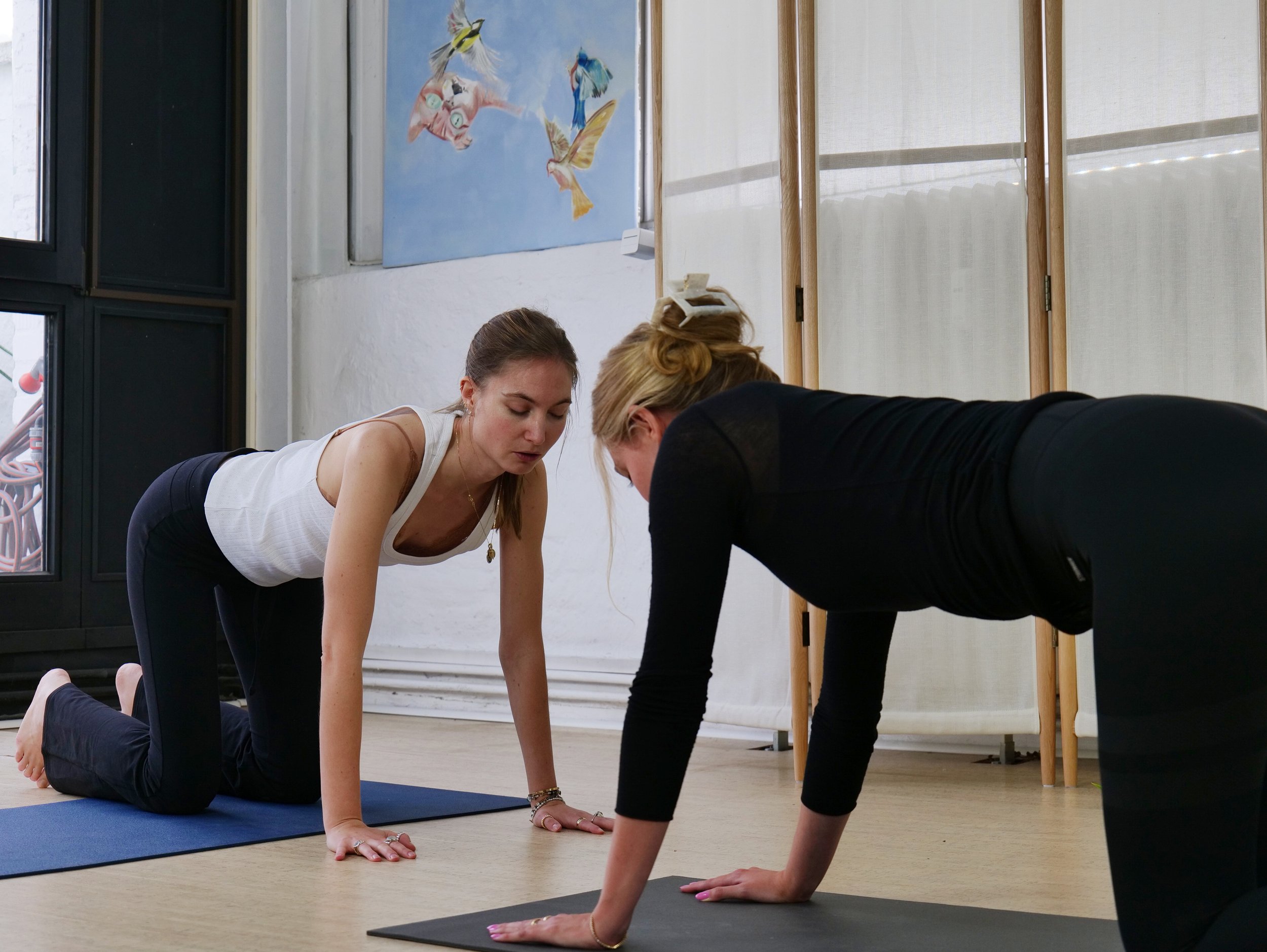
Last weekend, I spent four hours exploring the handstand with a wonderful group of people.
Many of the participants came from different sporting backgrounds, from bouldering and climbing to pole dancing, Pilates and yoga. They brought with them a variety of physical skills, experiences and ways of working with their bodies.
What I particularly enjoyed observing throughout the training was how much easier a physically challenging movement could become once the participants began to change the quality of how they moved. Often, it was not a question of developing more strength, but of finding a different way of working with the strength and physical abilities they already had.
There are two aspects of this experience that I would like to share, both of which relate to something we call Körpergefühl in German. I understand this as something more expansive than body awareness. It is a feeling for the body, for the relationships within it and for the way it relates to its surroundings. It can be cultivated and, in turn, can considerably expand our physical possibilities.
Creating room for movement
We began the training by looking into our own bodies. Through a series of relatively simple movements, we explored how interconnected the body is, how a small shift in weight, a release of tension or a movement in one part of the body can change what happens elsewhere.
One of the things I work with a lot in my movement practice is active relaxation. I am interested in how much of the body can remain relaxed and available to movement while performing a physically demanding task.
There is a beautiful German word for what this creates within the body: Spielraum (literally meaning “room to play”). It describes the room something has to move, to adjust, to respond and to develop.
When you release unnecessary muscular tension, you create more of this room within your body. A small shift in weight can allow and initiate a movement elsewhere, different parts of the body can respond to one another, and a movement can develop more fluently through the whole body. At the same time, you become more perceptive of these subtle changes and can increasingly work with them.
This is what I mean when I speak of softness in movement. It is not necessarily a gentle or slow way of moving. You can move with considerable strength, speed and dynamism while retaining this quality. What interests me is how available the body remains to movement, even while exerting strength.
In a handstand, where the body is continuously making small adjustments to find and maintain its balance, this becomes particularly valuable. Rather than trying to control every part of the body individually, you can develop a feeling for how the whole body participates in the movement, from the moment you begin to approach the floor to the moment your feet leave it.
It is a beautiful experience when something that previously required a great deal of effort suddenly becomes a fluent movement.
Developing a relationship with the floor
The other aspect we explored during the training was the relationship between the body and its surroundings. In the case of the handstand, this is quite literally the relationship with the floor.
For many people, the floor becomes somewhat intimidating when learning a handstand. There is the unfamiliar experience of carrying your weight on your hands, the possibility of falling and the anticipation of a physically demanding movement. All of this can already create considerable tension in the body before the movement has even begun.
I wanted the participants to develop a different relationship with the floor.
We spent time exploring what it feels like to lean into something, to gradually give your weight to a surface and to discover how your body can remain comfortable while doing so. Through different sensory experiences, we developed a feeling for the way we establish contact with our surroundings.
How do you place your hands on the floor? Can you feel the surface beneath them? How comfortable are you giving more and more of your weight to it? And can you remain comfortable as the demands on your strength increase?
I find the notion of care particularly interesting in this context. What happens when you bring the same care to the way you touch the floor as you would to the way you touch another person? When you take an interest in how you establish contact, how you lean and how your body responds to being supported?
I invited the participants to remember the physical sensations we had explored earlier in the training and to bring that same quality of touch, that same comfort and care, into their handstands.
The floor can become something helpful, something you can lean into and that is there to hold you. Developing a familiarity with this sensation can make the experience of going upside down considerably less intimidating. And it is interesting to observe how a change in the way you relate to your surroundings can also change the way you organise your own body.
Developing physical abilities through the quality of movement
What I love about working with physically challenging movements in this way is that the process of learning becomes an interesting experience in itself. There is so much to discover within a movement, even one that you have performed hundreds of times before. How much effort does it actually require? What happens when you release a little tension somewhere? How does the movement change when you approach it with a different intention, or when you become more comfortable with a particular sensation?
These are things you gradually develop a feeling for. And the more refined this feeling becomes, the more possibilities you begin to discover within your own body.
The handstand is a particularly interesting example, but what we explored during those four hours is something you can bring into almost any movement practice, as well as into the way you move throughout your day.
I find it incredibly rewarding to see people discover that they are capable of doing things they previously found difficult, not necessarily because they have become stronger, but because they have developed a better feeling for how to work with their own bodies. And what I enjoy most about this approach is that, in developing our physical abilities, we can simultaneously cultivate a more attentive, comfortable and caring relationship with our bodies.
The quality of the experience becomes part of what allows us to progress.