How to make arm balances feel lighter and more controlled
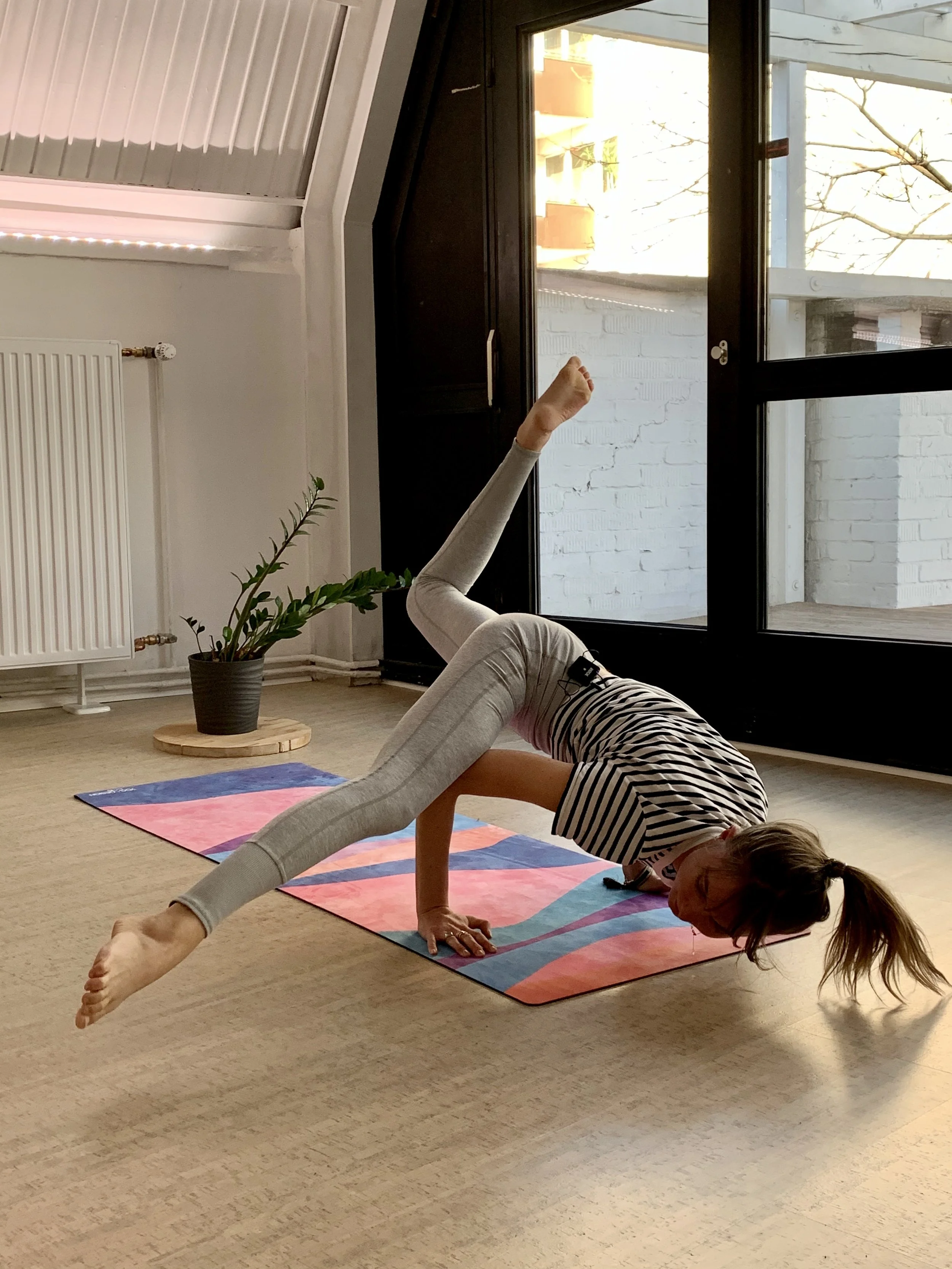
Arm balances are often treated primarily as a test of strength. When people struggle to lift their feet from the floor, the obvious conclusion is that their arms, shoulders or abdominal muscles are not yet strong enough.
Strength is certainly involved. But it is rarely the only reason an arm balance feels difficult.
A person may be strong enough to support their body and still feel unusually heavy, compressed or unstable. They may repeatedly practise the final pose without understanding how to transfer their weight into it, how to make one part of the body light enough to move, or how to reorganise the body around a new base of support.
In my arm-balance workshops, we therefore do not begin by repeatedly trying to hold the final position. We begin with the movement that makes it possible.
An arm balance is a process of shifting weight
Before the feet can leave the floor, the weight they are carrying has to travel somewhere else.
This sounds obvious, but it is often the part of an arm balance that receives the least attention. People concentrate on lifting their legs when the more important action may be shifting enough weight into the hands to allow the legs to become light and leave the floor by themselves. The body does not need to be lifted as one solid object. Its weight can be redistributed. As the relationship between the hands, feet, arms, legs and torso changes, the body reorganises itself.
This is one reason an arm balance may suddenly become possible without a dramatic increase in strength. The person has not become stronger within a few minutes. They have learned to use their strength more effectively.
Creating enough space to move
Consider a transition from crow into eight-angle pose.
In this variation, the inner thighs make contact with the upper arms rather than placing only the knees onto them. This creates a broader, more responsive and stable connection between the legs and upper body.
.From there, the weight can be shifted more strongly towards one side. As the opposite side becomes lighter, this part of the body can relax, free itself and become movable. The hips can lift slightly, creating enough space for the foot and leg to travel through the arms. Space does not only mean the visible distance between parts of the body. It is also the room within a movement that allows the body to adjust and change direction. The leg is not pulled through by force alone. Its movement becomes possible because it has first been unweighted. We reorganise the support around the new position.
Relaxing muscles, softening, contributes to this space. When unnecessary tension is released, the joints remain responsive and different parts of the body can move in relation to one another. The torso can shift, the hips can lift and the leg can change direction.
These intermediate actions are easy to overlook when attention is directed only towards the final shape. Yet they determine whether the movement feels mobile, spacious and controlled or cramped, contained and strenuous.
Why more tension does not necessarily create more control
When an arm balance feels insecure, many people instinctively become more rigid. They grip with their hands, harden their arms and shoulders and hold the torso as firmly as possible. Some muscular activation is necessary. But when tension becomes excessive, the body loses mobility and the ability to adjust its weight.
Balance is not a fixed state. Even when a position appears still, pressure continues to change across the hands. The shoulders respond, the torso shifts and the body continually refines its relationship to the floor.
If the arms and shoulders are already locked, there is very little Spielraum left for these adaptations. The person may be able to force themselves briefly into the pose, but they cannot respond easily once they are there.
Relaxing muscles should therefore not be confused with a lack of strength. It allows us to distinguish between the effort that supports the position and the tension that restricts it. Greater control often comes not from making every part of the body harder, but from understanding where strength is needed and where movement must remain available.
The arm balance begins before the feet lift
Anything begins with how we get there: the tension and relaxation in the body, the placement of the hands, the direction of the torso and the first transfer of weight away from the feet. When these actions are coordinated, the feet may lift almost as a consequence of what has already happened. When they are not, the person often compensates by jumping, pulling or producing more force.
From one pose to a broader movement skill
Arm balances make these principles especially clear because the demands of the position amplify what is already happening.
An inefficient weight transfer can make the body feel much heavier than it is. Excess tension can restrict the ability to adjust. A lack of participation from the torso can leave the arms carrying more than necessary. But these are not only arm-balance problems. We continually redistribute weight in order to make another part of the body available for movement. We do this when changing direction, moving closer to the floor and transitioning from one position into another.
Learning an arm balance can therefore become a precise way of studying how movement works. The aim is not simply to place the body into a difficult shape. It is to understand how support, weight distribution, space, strength, softness and whole-body participation make that shape possible. When the movement leading into a position becomes more coordinated, the position itself often becomes lighter, more stable and easier to adapt.
Experience the approach
In my upcoming workshops, we will explore these principles through movement and apply them directly to arm balances and handstands.
Arm Balances & Inversions
Sunday, 9 August 2026
15:30–17:30
Handstand Workshop
Saturday, 15 August 2026
15:30–17:30
Bookings are available through my website or Rausgegangen.